Capturing the Stuff of Space
Comet dust and the clay of exploded stars hurtled into Earth's atmosphere and landed safely in the Beehive State desert last month. The material arrived exclusive a ejector seat ejected by the Stardust ballistic capsule.
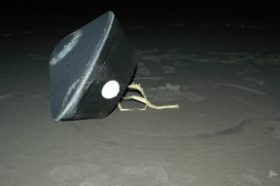 |
| Carrying a cargo of comet grains and stardust, the Stardust capsule landed in the UT defect on January. 15, 2006. |
| NASA/JPL |
Scientists are now teasing out tiny comet fragments from a protective gel inside the Stardust capsule. In addition, they're interrogatory for your help to smirch the grains of stardust that the capsule as wel captured and brought back to Earth.

By perusing these bits of place material, the investigators desire to learn Thomas More about comets, stars, and the blood line of the star system.
Long navigate
The Stardust spacecraft was launched from Earth in February 1999. Since then, it's traveled 2.88 1E+12 miles. In January 2004, on its second loop round the insolate, Stardust brushed past the comet Enthusiastic 2.
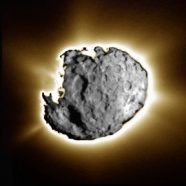 |
| This image of Frantic 2 shows the comet's rough surface and gasoline moving into space, going long trails. |
| NASA/JPL |
The spacecraft came inside 149 miles of the comet, snapped its picture, and captured bits of comet dust in a special sample-collection tray.
Catching comet dust isn't an easy task. Even though they're small, the particles wing toward a ballistic capsule at a rate up to septet times as fast as that of a speeding bullet.
To slow down, trap, and cushion the dust, scientists filled the grids in the sample tray with a material better-known as aerogel, sometimes called "dreary smoke." Aerogel is a strong but extremely luminosity heart that is 99.8 percent air.
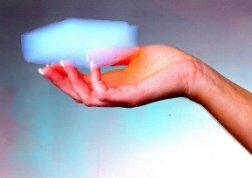 |
| Although aerogel has a supernatural appearance, it feels every bit semisolid and hard as a pick of Styrofoam. |
| NASA/JPL |
Scientists didn't know what to ask when they yawning the Stardust capsule on Jan. 17. They were excited to see thousands of tracks left aside fragments of Wild 2.
"We were relieved that anything survived at all," says Don Brownlee. He's the lead scientist with the Stardust project and a professor at the University of Washington in Seattle. "We didn't know how the particles would survive during fascinate."
Daucus carota sativa and hedgehog tracks
When Brownlee and his colleagues looked at the gel, they saw that the particles had left a variety of tracks when they careened into the sample tray.
Both particles went straight into the mousse, leaving a carrot-shaped track as they slowed and sooner or later came to rest, Brownlee says. Other comet grains came separated when they stumble the gel, creating a bulbous hole at the turn up earlier narrowing to a turnip soma.
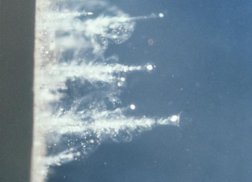 |
| In an experiment happening Earth, researchers used a special gun to fire particles into an aerogel. As the particles slowed to a plosive consonant, they left carrot-shaped tracks. |
| NASA/JPL |
Sometimes, little pieces stone-broke off from the chief comet grain, changing a turnip-shaped track into 1 that resembled a floccose, heavily ramous root.
But when some big particles slammed into the gel, the tracks looked less like a vegetable and more alike a prickly animal.
"The biggest ones made . . . cavities that populate draw as hedgehogs," Brownlee says. These particles, hardly telescopic to the naked eye, left tracks half-a-centimeter wide. Smaller pieces stony-broke polish off to form the Erinaceus europeaeus's spikes.
Dust removal
The researchers have a variety of exceptional tools to get the comet dust out of the gel. Practical in a superclean room, they use tiny, computer-controlled needles that jab the bodied over and over once again, eventually cutting out a wedge containing a dust particle. They use of goods and services knives made of steel operating theatre baseball diamond to slice along a dust track. Additionally, the scientists can use microtweezers and miniature forks to snag comet grains.
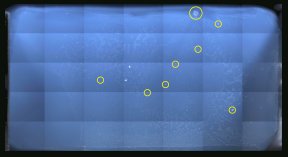 |
| The yellow circles mark spots where large particles entered this aerogel roofing tile, which is 4 centimeters weeklong and 2 centimeters wide. |
| NASA/JPL |
The scientists now contrive to analyze the disperse to see what chemical compounds it contains.
The particles that Stardust collected particular date to the clock time when Wild 2 was created—4.5 to 4.6 billion years ago. "We believe that [these particles are] the original building blocks of the solar organisation," Brownlee says.
The particles could provide answers to questions not single about comets but also about the origins of our Sunday, Earth, and the other planets.
A explore for stardust
Scientists with the Stardust mission will also look into interstellar dust—stardust, for short. These particles are created when a star is dying operating theater explodes. The Stardust capsulate self-possessed samples of interstellar dust victimisation the rearward of the comet-dust collector.
We can get a common sense of what stardust is like from faraway observations, says Bryan Mendez, an astronomer at the University of California, Berkeley. But at once, researchers will first have actual samples of stardust to analyze and consider.
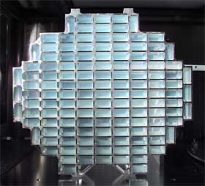 |
| This set of aerogel tiles collected comet grains and interstellar dust. |
| NASA/JPL |
First, however, the researchers have to find the stardust. There will probably live only 45 more or less particles in the aerogel. The width of each subatomic particle is less than that of a human fuzz, Mendez says. Looking for these particles in the taste tray is like looking 45 ants on a football field.
So, Mendez and other scientists are seeking the unrestricted's help.
The researchers will bring out about 1.5 cardinal "movies," apiece one a set of images of a microscopic aerogel section no large than a grain of salt. Volunteer detritus finders, who will be drilled to spot stardust tracks, can and then download and watch the micromovies on their Internet browsers.
Volunteers leave be victimisation their computers to coiffe proper science, Mendez says. "We take to find these particles ready to study them. With an army of Volunteer scientists, we can bang pretty quickly."
The micromovies won't be ready until late March. Just you can record to be a volunteer right right away. Conscionable proceed to stardustathome.ssl.George Berkeley.edu/. Astronomy buffs of any age can participate, Mendez says. All they need is a little bit of patience.
As a bonus, Mendez adds, anyone World Health Organization finds a star speck leave get to name it!
Going Deeper:
Extra Data
Questions about the Article
Logos Find: Stardust
0 Response to "Capturing the Stuff of Space"
Post a Comment